How to Hang Balloons from the Ceiling Without Losing Your Mind (Or Your Security Deposit)
Why Your Ceiling Needs Balloons (And How Not to Screw It Up)
Contents
Look, I get it.
You’re wondering if this is worth the effort or if you’ll end up with tape residue all over your ceiling and balloons on the floor by the time guests arrive.
I’ve thrown enough parties to know that balloon decorating isn’t rocket science, but it does require knowing which method works for your specific situation.
Here’s what I’ve learned through trial and plenty of error:
The success of your balloon ceiling depends entirely on three things—your ceiling type, whether you’re using helium, and how long you need these suckers to stay up.
The Dead Simple Methods That Actually Work
Helium Balloons: The Easy Route
Helium balloons are your best friend if you don’t want to fight with gravity.
I tie each balloon to colorful ribbon or fishing line, then secure the string to the ceiling with whatever adhesive makes sense for my surface.
Space them evenly across the ceiling—I usually eyeball it, but if you’re the measuring type, go for it.
The balloons naturally float upward, so you’re just guiding them into position rather than forcing them to defy physics.
Pro tip from my last wedding gig: Let the balloons float up first, then adjust the string length from below rather than trying to perfectly measure everything beforehand.

Non-Helium Balloons: Work Smarter, Not Harder
Regular air-filled balloons need support structures.
I’ve had the most success with these anchor points:
- Balloon garland strips (seriously, these changed my life)
- Fishing line strung across the room
- Command hooks on opposite walls
- Existing light fixtures or ceiling fans (when appropriate)
- Decorative string lights that pull double duty
The key is creating a framework first, then attaching balloons to it.
Don’t try to stick individual balloons directly to the ceiling unless you enjoy pain.
The Adhesive Breakdown: What Sticks and What Sucks
I’ve tested every adhesive known to party planners.
Here’s my honest take:
Double-Sided Tape: The Reliable Workhorse
Double-sided tape is my go-to for smooth ceilings and lightweight balloons.
It disappears visually, holds surprisingly well, and removes cleanly if you don’t leave it up for months.
I learned this the hard way after once leaving decorations up for three weeks—the tape bonded with my ceiling like a bad relationship.
Best practices:
- Use small pieces, not giant strips
- Press firmly for 30 seconds
- Test a corner first if you’re paranoid about your paint
- Remove within a week for easiest cleanup
Tacky Putty: The Reposition Champion
This stuff is forgiving.
I use poster putty when I’m still figuring out my design or when I’m decorating a rental space where I’m terrified of damage.
Roll it into small balls, press it onto the balloon knot, then push it against the ceiling.
You can adjust positions throughout the day without starting over.
The downside? It doesn’t hold as long as tape, especially in warm rooms where it gets soft.
Glue Dots: Proceed with Caution
Glue dots work great temporarily, but I’ve had them pull paint off before.
My rule: Only use them on surfaces I don’t care about, or cover them with painter’s tape first.
The painter’s tape creates a protective barrier between the glue dot and your ceiling, and you can remove the whole thing cleanly later.
Fishing Line and Hooks: The Professional Look
This is my favorite method for events where I want precise control over height and arrangement.
I install clear ceiling hooks or use existing ceiling fixtures, then run fishing line to create a grid pattern.
Individual balloons tie to the intersection points.
Why I love this:
- Creates varied heights effortlessly
- Looks intentional, not random
- Easy to adjust on the fly
- The fishing line is practically invisible
- Works for both helium and air-filled balloons
For my best friend’s baby shower last month, I created a cascading effect with balloons at three different heights using this method.
Everyone asked who I hired to do it.

Balloon Garlands: The Game-Changer You Need to Know About
Stop hanging individual balloons like it’s 1995.
Balloon garlands save you hours and look infinitely more polished.
Here’s my process:
- Inflate balloons to varying sizes (this creates visual interest)
- Thread them onto a balloon decorating strip
- Fill in gaps with smaller balloons
- Add greenery or flowers if you’re feeling fancy
- Hang the entire garland as one piece
I can create a 10-foot garland in about 45 minutes now.
The first time took me three hours and several frustrated tears, but you learn.
The math you need: For a lush, full garland, I use approximately 6-8 balloons per foot of length.
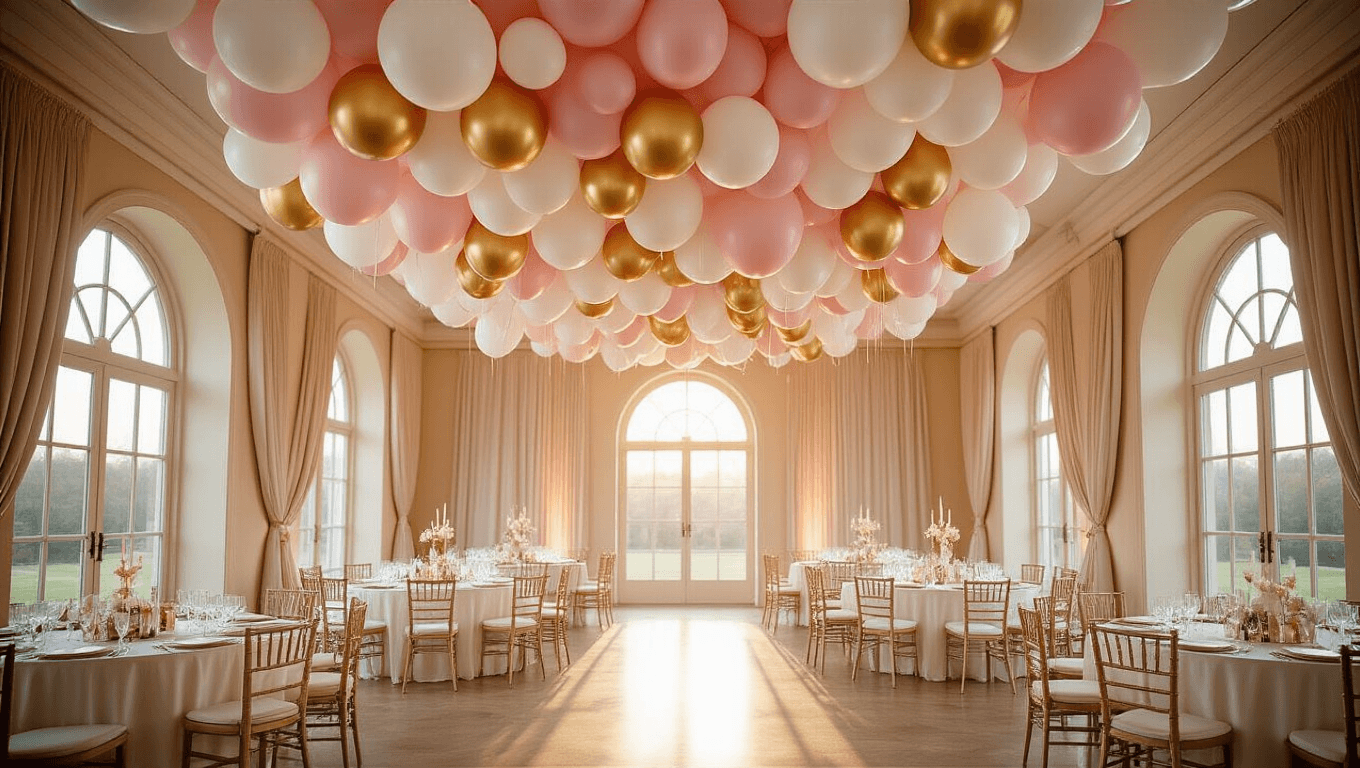
For ceiling coverage, plan on 14-15 standard 30cm (12-inch) balloons per square meter.
Yes, this means you need way more balloons than you think.
Buy extra.
Trust me.
Specialized Setups for the Ambitious
Balloon Nets: The Lazy Genius Solution
Balloon nets are pre-made with holes sized perfectly for balloons.
You stuff balloons into the holes, then hang the entire net at once.
I’ve used these for large ceiling installations where time was tight.
They work, but they look a bit uniform for my taste—great for corporate events, less exciting for creative celebrations.
Hanging Balloon Kits: The Long-Term Option
These plastic sphere frameworks hold air-filled balloons and can last for months.