
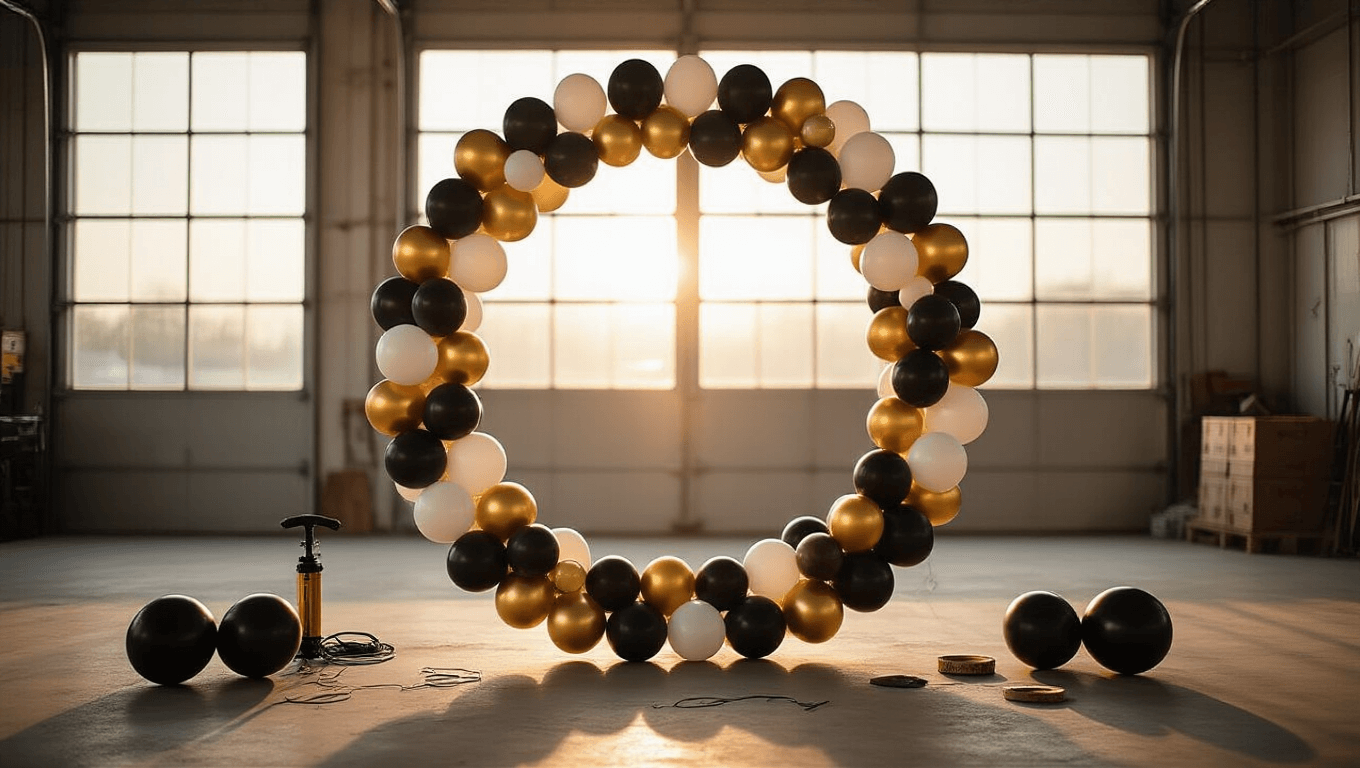
How to Create a Stunning Round Balloon Backdrop That’ll Make Your Party Unforgettable
How to Create a Stunning Round Balloon Backdrop That’ll Make Your Party Unforgettable
Contents
A round balloon backdrop transforms any celebration from “meh” to “wow” faster than you can say “photo op.”
I still remember staring at those gorgeous circular balloon displays on Pinterest, convinced they required some kind of wizardry or a professional party planner’s budget.
Turns out, I was wrong.
After creating my first round balloon backdrop for my sister’s bridal shower (and saving about $300 in the process), I’m here to tell you that you absolutely can pull this off yourself.
Let me show you exactly how.
Why a Round Balloon Backdrop Will Steal the Show at Your Next Event
Here’s the thing about circular balloon garlands.
They photograph like absolute magic.
That round shape creates this frame-within-a-frame effect that makes every photo look professionally staged, even when Uncle Bob is taking pictures with his shaky hands.
I’ve used these backdrops for:
- Birthday parties that needed that Instagram-worthy corner
- Baby showers where the mom-to-be deserved all the attention
- Wedding receptions that required a stunning photo spot
- Graduation celebrations that marked major milestones
The circular design works because it draws the eye inward, making whoever stands in front of it the undeniable star of the photo.
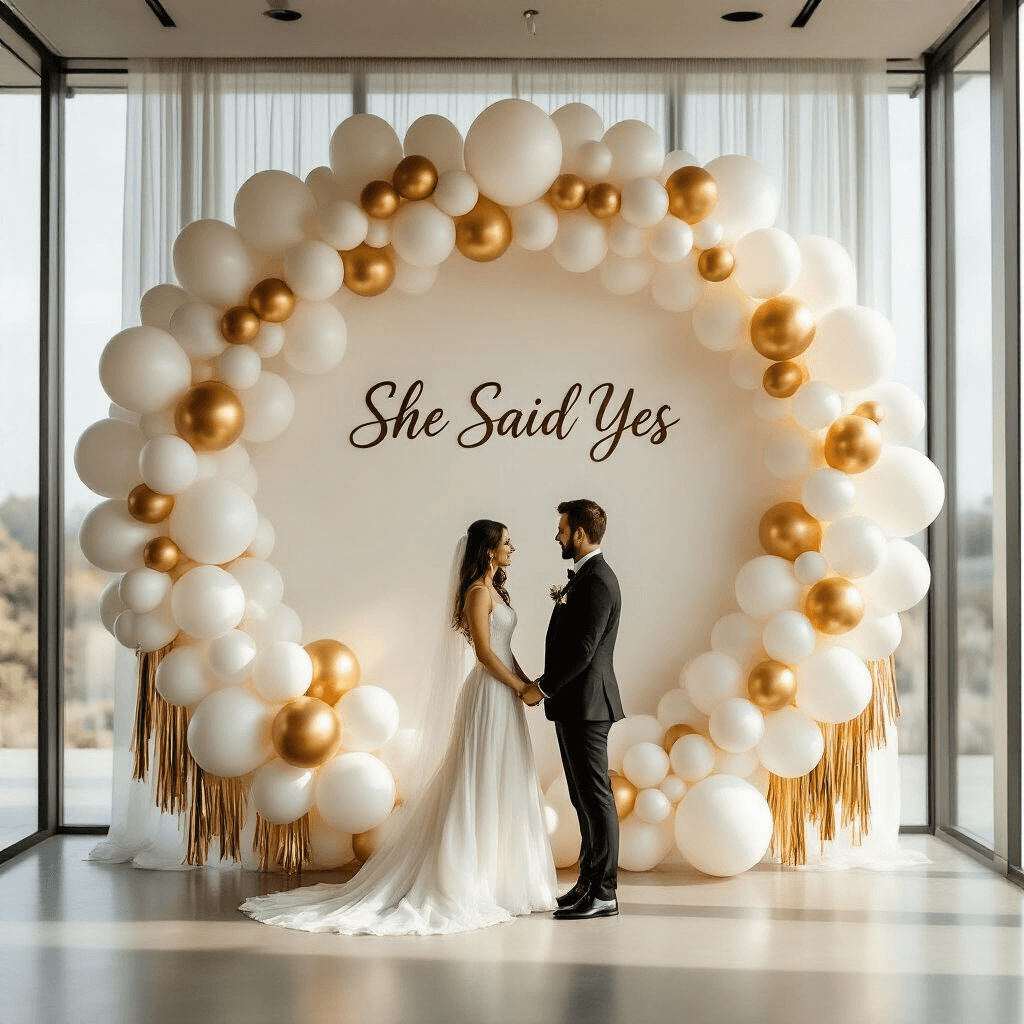
Everything You’ll Need to Build Your Round Balloon Backdrop
Let’s talk supplies.
Don’t skip anything on this list unless you enjoy making your life unnecessarily difficult.
The Essential Foundation
The backdrop stand makes or breaks this project.
You need a circular balloon backdrop stand that’s sturdy enough to hold dozens of balloons without toppling over.
Most circular frames measure around 10 feet tall by 10 feet wide, which creates that perfect photo-op size.
I learned this the hard way when I tried using a flimsy frame for my first attempt and watched the whole thing slowly lean forward like the Tower of Pisa throughout the party.
Not cute.
Balloons in All the Right Sizes
Here’s where most people mess up.
They buy one size of balloon and wonder why their backdrop looks flat and boring.
You need variety:
- 5-inch balloons – These tiny guys fill gaps and add texture
- 11-inch balloons – Your workhorse size that forms the main structure
- 18-inch balloons – Statement pieces that add visual interest
- 260 balloons – Those long, skinny ones that work as connectors
Grab a variety pack of balloons that includes multiple sizes in complementary colors.
My go-to color combo?
Chrome gold, crisp white, elegant black, and soft white sand create this sophisticated vibe that works for literally any celebration.
But you do you.
Pastels for baby showers, bright primaries for kids’ birthdays, jewel tones for fancy events – the world is your balloon-filled oyster.
Tools That Save Your Sanity
Get an electric balloon pump.
Seriously.
I manually inflated balloons for my first backdrop and my cheeks hurt for three days.
An electric balloon pump will save your breath, your time, and possibly your marriage if your partner is helping you.
You’ll also need:
- Rubber bands or extra 260 balloons for connecting clusters
- Gaff tape to cover any sharp edges on your frame (nothing kills party vibes like random balloon pops)
- Fishing line or clear string for extra security on outdoor setups
- Command hooks if you’re attaching anything to walls
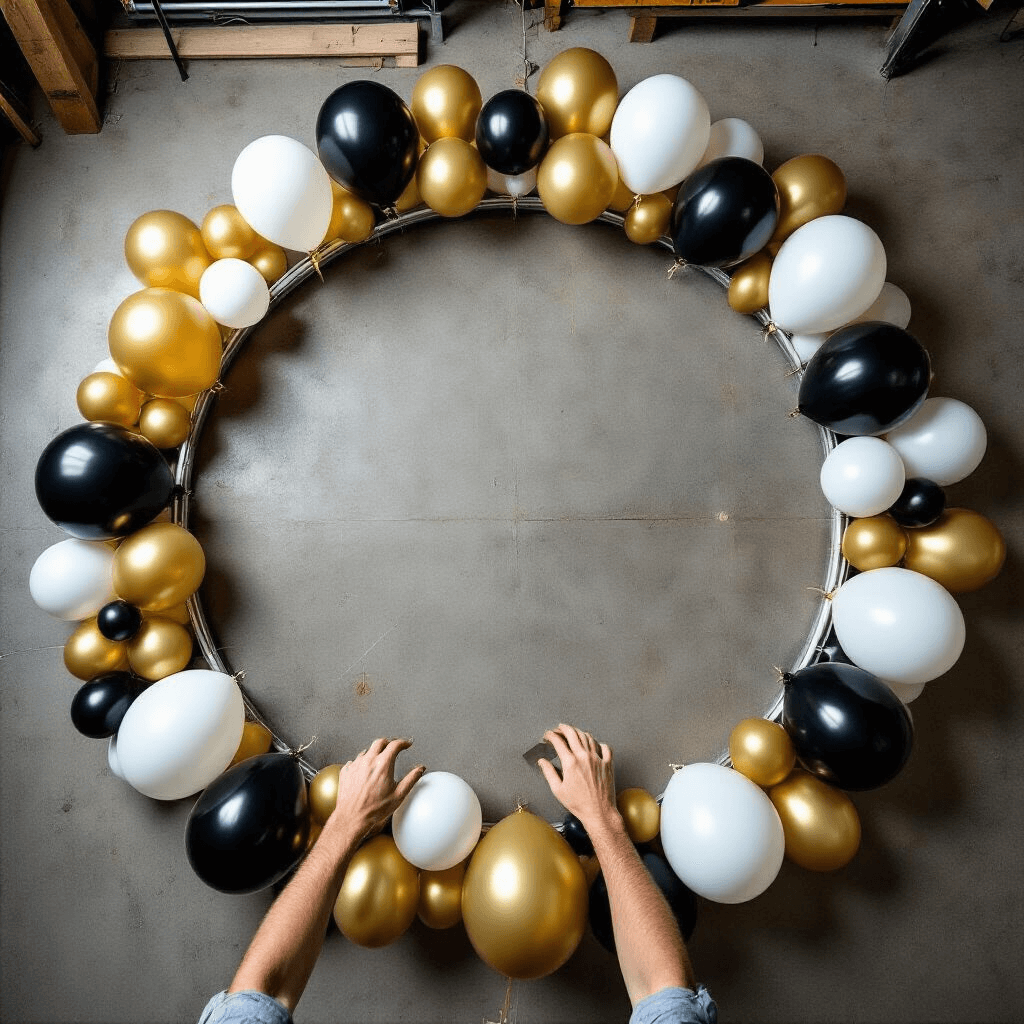
The Step-by-Step Process That Actually Works
Okay, let’s build this thing.
Clear a decent workspace because you’ll need room to move around your frame.
I usually set up in my garage or a large room where I can walk completely around the circular stand.
Step 1: Prep Your Frame Like a Pro
Before you touch a single balloon, wrap any sharp joints or connections on your frame with gaff tape.
Trust me on this.
One pointy screw or metal edge will pop balloons all day long, and you’ll want to throw the whole project in the trash.
Gaff tape is better than regular duct tape because it doesn’t leave sticky residue and holds better.
Set up your circular frame in its final standing position.
You want to work on it upright, not lying flat, because gravity affects how the balloons hang.
Step 2: Create Your First Balloon Clusters
This is where the magic starts.
Inflate two 11-inch balloons to roughly the same size (they don’t need to be perfect – slight variations actually look better).
Tie the necks together.
Repeat with two more balloons.
Now twist these pairs together to create a cluster of four balloons.
Here’s the secret nobody tells you:
Don’t make them all exactly the same size.
Inflate some to 10 inches, some to 11 inches, some to 12 inches.
This organic variation is what separates amateur balloon backdrops from ones that look professionally designed.
Make about 20-30 of these four-balloon clusters before you start attaching anything.
Assembly-line style works way better than making one cluster at a time.
Step 3: Attach Clusters to Your Frame (The Method That Changed Everything for Me)
There are two main ways to attach balloon clusters.
The pole method:
Place your circular frame pole between two balloons in your cluster, right in that natural gap where they meet.
Pull the balloons up from the middle.
Twist the cluster around the pole.
The balloons lock themselves in place through friction and pressure.
The neck-tie method:
Tie the necks of balloons from different clusters together, wrapping them around the frame as you go.
This takes longer but creates a more secure hold for outdoor events where wind might be a factor.
I usually combine both methods.
Pole method for speed, neck-tie method for areas that need extra security.
Start at the bottom of your circular frame and work your way around and up.
Attach clusters close together, overlapping them slightly.
You want full coverage with no frame showing through.
Step 4: Layer and Fill for That Professional Look
Here’s where your backdrop goes from “nice try” to “did you hire someone?”
After your base layer of 11-inch balloon clusters is attached all the way around, grab your other sizes.
Add 18-inch balloons strategically:
- Don’t put them all in one section
- Distribute them evenly around the circle
- Use them to fill larger gaps or create focal points
Tw


