
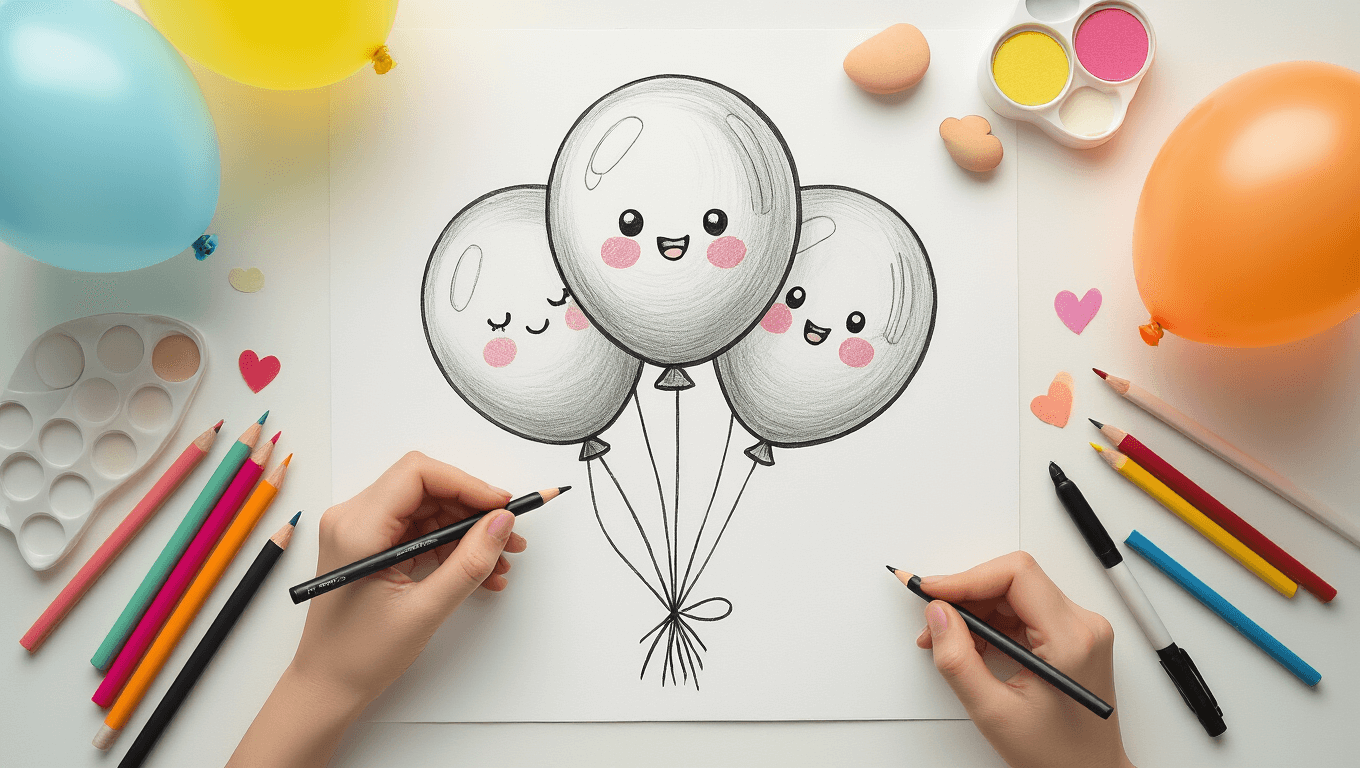
How to Draw Balloons: From Simple Sketches to Show-Stopping Designs
How to Draw Balloons: From Simple Sketches to Show-Stopping Designs
Contents
How to draw balloons stumped me for years until I realized I was overthinking the whole thing.
You know that moment when you’re making a birthday card or planning party decorations and you think, “I’ll just draw a cute balloon!” Then you grab your pencil and suddenly your brain goes completely blank?
Yeah, I’ve been there more times than I’d like to admit.
The good news is that drawing balloons doesn’t require art school credentials or fancy supplies. I’ve taught my kids, my nieces, and even my skeptical mother-in-law how to sketch these cheerful little things, and honestly, if they can do it, anyone can.
Why Your Balloon Drawings Look… Off
Before we dive in, let’s talk about the elephant in the room.
Most people’s balloon drawings look flat, lifeless, or just plain weird.
The problem isn’t your artistic ability.
It’s that you’re missing one tiny detail that makes all the difference: dimension.
A balloon isn’t just a circle with a string. It’s a rounded, three-dimensional object that catches light and has texture. Once you understand this, everything clicks into place.
The Dead-Simple Basic Balloon (Start Here)
I always start beginners with this method because you literally cannot mess it up.
Grab a pencil and follow along:
Step 1: Create Your Circle
Draw a circle near the top of your paper.
Can’t draw a perfect circle freehand? Neither can I.
Use whatever’s nearby—a bottle cap, a roll of tape, the bottom of a coffee mug. I keep a set of circle templates in my craft drawer specifically for this, and they’ve saved me countless times.
Step 2: Add the Balloon Lip
Right below your circle, draw a small horizontal shape that looks like tiny wings.
Make the bottom edge slightly ruffled or wavy. This is where the balloon gets tied off, and it naturally bunches up a bit.
Don’t stress about making it perfect. Real balloons have imperfect lips too.
Step 3: Sketch That String
From the center of the lip, draw a gently curving line downward.
Make it wavy. Make it bouncy. Strings never hang perfectly straight because physics exists.
I usually make mine curve to one side, then gently back, creating a natural S-shape.
Step 4: The Magic Touch—Add Dimension
Here’s where your balloon goes from “meh” to “hey, that actually looks like a balloon!”
On the upper-right area of your circle (around 2 o’clock if you’re thinking of it as a clock face), draw a small curved square or rectangular shape.
This is your highlight—the spot where light hits the shiny balloon surface.
You can also add a smaller dot of highlight nearby for extra punch.
Step 5: Color That Baby In
Grab your colored pencils, markers, or crayons.
Leave that highlight area white or very light.
Make the areas opposite the highlight slightly darker to show shadow.
Boom. You’ve got yourself a balloon that actually looks three-dimensional.
The Adorable Kawaii Balloon (For Cards and Crafts)
Once I mastered the basic balloon, I got a little ambitious.
My daughter asked me to make birthday cards for her entire class, and I needed something with more personality.
Enter the kawaii balloon—basically a balloon with a face and enough cuteness to cause cavities.
Creating the Face
Start with your basic circle shape.
Now add:
- Two large circular eyes positioned slightly below the center
- Smaller circles inside for pupils
- Tiny white dots in the pupils for that shiny, innocent look
- A small curved smile below the eyes
Keep the features small and positioned in the lower half of the balloon. This makes it look extra cute and childlike.
Decorative Elements
Add some flair around your kawaii balloon:
- Small hearts floating nearby
- Stars or sparkles
- Confetti dots
- Little motion lines to show it’s floating
I draw these decorations in pencil first, then outline everything with fine-tip black markers before coloring.
Color Strategy
For kawaii-style drawings, stick with:
- Pastel or bright, cheerful colors
- Rosy cheeks (add small pink circles)
- White or light highlights kept prominent
These drawings are perfect for birthday cards, party invitations, or just doodling when you’re bored in meetings (not that I’d know anything about that).
The Impressive Hot Air Balloon (Level Up Your Skills)
After you’ve nailed regular balloons, hot air balloons are the natural next step.
They look complicated, but they’re just fancy balloons with extra steps.
The Balloon Envelope
Draw a large oval shape—wider at the top, narrower at the bottom.
Think of it as an upside-down teardrop that got squished a bit.
Adding the Panels
This is where it gets interesting.
Draw a vertical line straight down the center of your oval.
Then add curved lines on either side, following the contour of the balloon. These represent the different colored panels you see on real hot air balloons.
Add about 4-6 panels total for a realistic look.
Creating Horizontal Sections
Draw gentle curved lines horizontally across your balloon.
These should curve downward slightly, following the rounded shape of the envelope.
Three to four horizontal sections usually does the trick.
The Basket
Below your balloon, draw a small rectangle or trapezoid shape (wider at top, narrower at bottom).
Add:
- Vertical lines inside to show wicker texture
- A criss-cross pattern for detail
- Small upside-down V-shapes along the top edge
Connecting Everything
Draw 4-6 vertical lines connecting the balloon to the basket.
These represent the cables that hold everything together